
A rigorous new study examining nearly one million students who enrolled in Texas public colleges and universities offers some of the strongest evidence yet that postsecondary education delivers a meaningful return on investment for most students while also sounding an important warning about the variation that may be disguised by averages.
What Makes This Study Uniquely Rigorous
Using Texas' high-quality longitudinal data system, made available through the Texas Higher Education Coordinating Board and the Texas Education Research Center, researchers from the Postsecondary Commission, in partnership with Mathematica, tracked 935,767 students who enrolled in 86 public institutions between 2008-09 and 2018-19.
This use of student-level enrollment and earnings data is unique because most analyses of the return on investment of college compare the earnings of students who attended college with those who do not. This one measures value-added earnings (VAE), or the difference in earnings between very similar students who did and did not pursue postsecondary education. This approach allowed the researchers to isolate the impact of postsecondary education itself, separate from student drive, knowledge and skills, that could lead them to earn more even without a postsecondary education.
To compile a strong comparison group, researchers matched students on the basis of an extensive set of characteristics including prior earnings, household income, high school test scores, race and ethnicity, age, gender, and geography. The model also included foregone earnings, meaning the opportunity cost of going to school.
Finally, the analysis included everyone in the dataset who started postsecondary education, not just those who completed or attended full-time, which allowed for a more comprehensive look at whether and for whom higher education pays off.
The Main Finding: Postsecondary Education Pays Off for Most Students
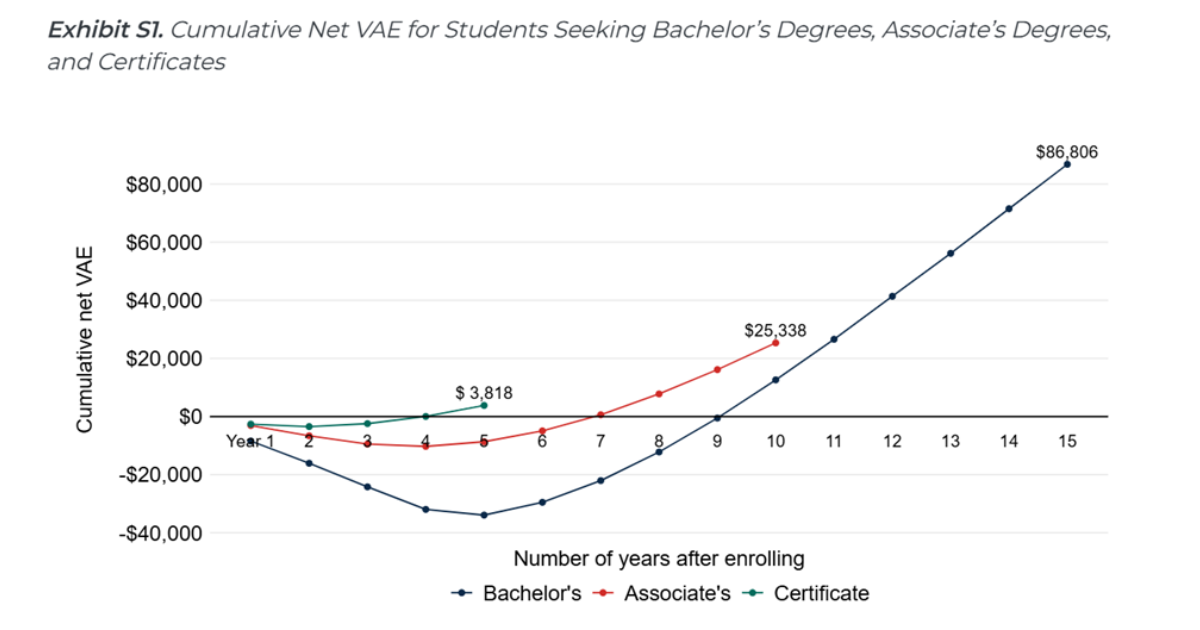
Across all three credential types, the average cumulative net value-added earnings were positive:
-
Bachelor's degree-seeking students reached a cumulative VAE of $86,806 15 years after entry.
-
Associate's degree-seeking students reached a cumulative VAE of $25,338 by year 10.
-
Certificate-seeking students reached a cumulative VAE of $3,818 by year five.
Students don't break even immediately, of course. The financial nadir came five years after enrolling in a bachelor's program (-$33,925), four years after starting an associate's program (-$10,282), and two years after enrolling in a certificate (-$3,461). But students cross into positive territory economically by year ten for bachelor's degree seekers, year seven for associate's degree seekers, and year four for certificate seekers.
Where It Gets Complicated
When the researchers disaggregated the results by institution, program, and demographic group, the picture became more nuanced:
-
Among certificate-seeking students, 64% of programmatic cohorts had negative VAE at year five. That's a striking finding that indicates that advisors should really dig in before recommending that students pursue short-term credentials.
-
Program choice explains more than institution choice. Across all three degree or credential types, which program a student chose within the same institution explained more of the variation in earnings than which institution of higher education they chose.
-
STEM vs. non-STEM: STEM programs consistently outperformed non-STEM programs in cumulative VAE across all credential types. Non-STEM certificate programs actually showed negative average VAE (-$2,789).
.png)
-
Institution choice explains more than household income. Perhaps most strikingly, a student's household income explained much less of the variation in earnings than the institution they attended. This finding indicates that institutional offerings, such as curricula and support services, matter a great deal for students’ futures.
-
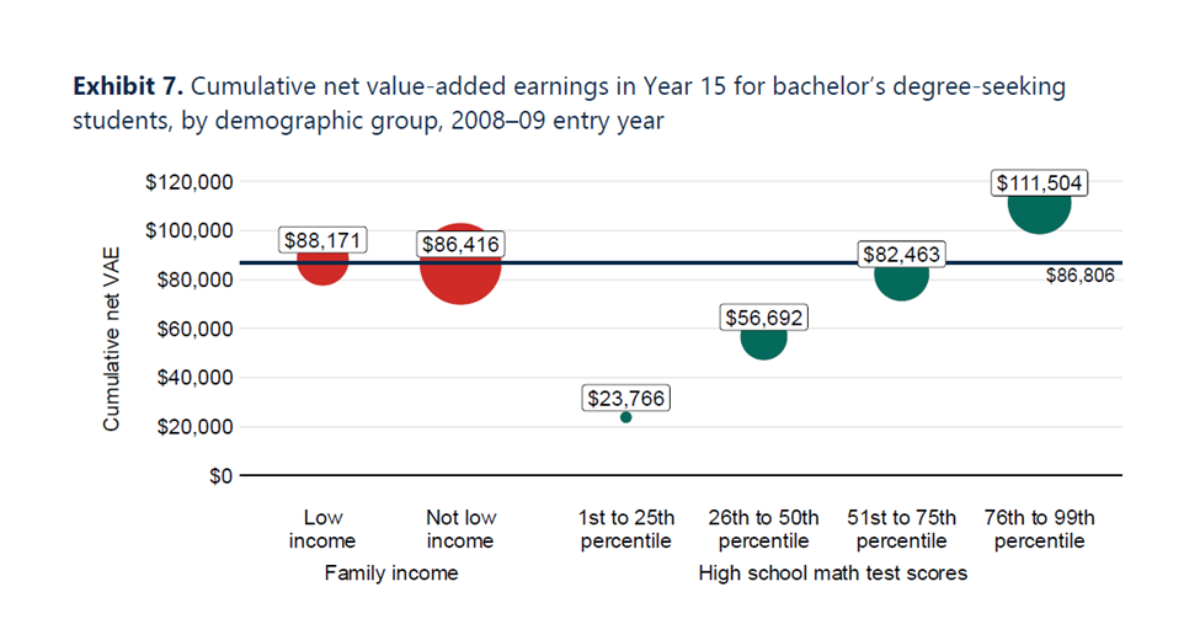
Low-income students pursuing bachelor's degrees had slightly higher cumulative VAE ($88,171) than their higher-income peers ($86,416), meaning a B.A. pays off the most for students from low-income families.
Policy and Advocacy Takeaways
For college access and attainment advocates, this study provides a proof point and a policy recommendation.
First, National College Attainment Network (NCAN) members should know and share widely that for most students, postsecondary education delivers a positive economic return even when lost earnings are factored in. To the rising concern about whether college is worth it, this study offers a powerful rebuttal that advocates should use in their communications.
At the same time, the variation in outcomes by program lends urgency to the need to provide students with program-level information about outcomes. Students considering short-term certificate programs in particular deserve to know whether the program they are considering is likely to pay off, especially if by pursuing it, they will use up some of their limited lifetime Pell Grant-eligibility.