
“I know who I am, I know where I’m going, and I know who can help me get there.” All students being able to assert these three things was the shared goal and vision for the authors of a new report from the Commission on Purposeful Pathways, supported by the Gates Foundation and led by Education First. The report, “A Launchpad for Life: A Vision for Purposeful Pathways for All Students,” released in March, is one that NCAN members will want to bookmark and return to frequently.
The Commission is co-chaired by Melissa Connelly, CEO of OneGoal, John Garcia III, Executive Director of the Pathways Impact Fund, and Paul Herdman, President and CEO of Rodel. Additional commissioners included, “leaders, practitioners, and researchers from K-12, higher education, and the workforce, alongside three current or recently graduated college students.”
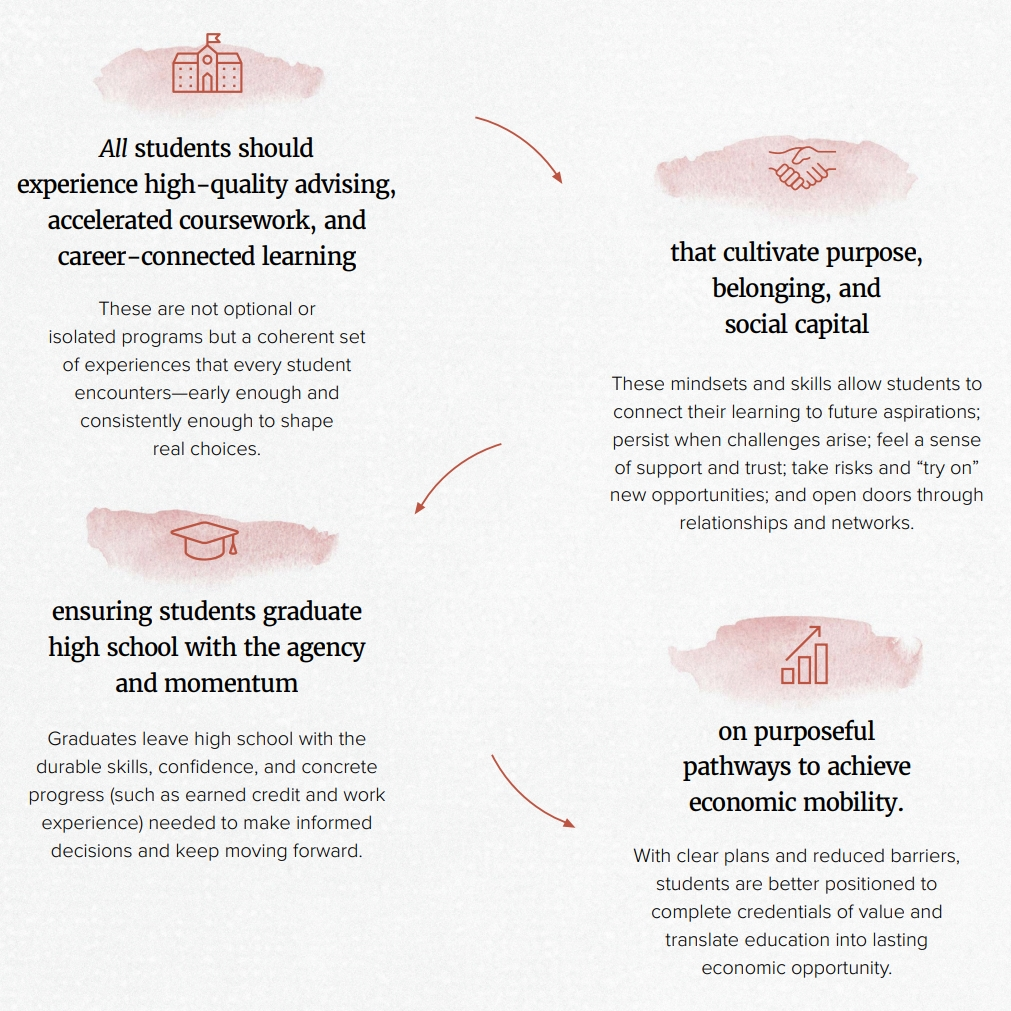
The commission’s vision is that “All students should experience high-quality advising, accelerated coursework, and career-connected learning that cultivate purpose, belonging, and social capital— ensuring that they graduate high school with agency and momentum on purposeful pathways toward economic mobility,” and the report makes four recommendations to the field for helping to realize that vision:
-
Provide all students with purposeful pathways.
-
Hardwire purpose, belonging, and social capital into every pathway.
-
Move the goalposts beyond the high school diploma to economic mobility.
-
Make student transitions a shared responsibility.
If readers of this article and National College Attainment Network (NCAN) members more broadly see themselves in this vision and advancing these recommendations through their programs and in their communities, great! If not, the report dives deeper into tactical actions stakeholders can take to work toward these fieldwide goals.
Rather than remain at the 10,000 foot level, the report returns repeatedly to a fictional student named “Ari,” whose “portrait is grounded in federal, state, and local data to reflect the reality of many of today’s high school students.” In the report’s telling:
Ari lives in Phoenix, AZ. She’s Latina, like more than four in 10 residents in the city. She attends a high school of about 2,000 students, where a majority qualify for free or reduced-price lunch. Ari’s mother works as a patient services coordinator, and her father is an HVAC technician. Outside of school, Ari has played soccer since she was 10, and she loves spending time with her younger siblings.
Many NCAN members serve students like Ari every day and help them navigate the many structural barriers on the way to fulfilling access and completion outcomes. The report suggests some of the fundamental changes that would be critical to assisting Ari and other students nationwide:
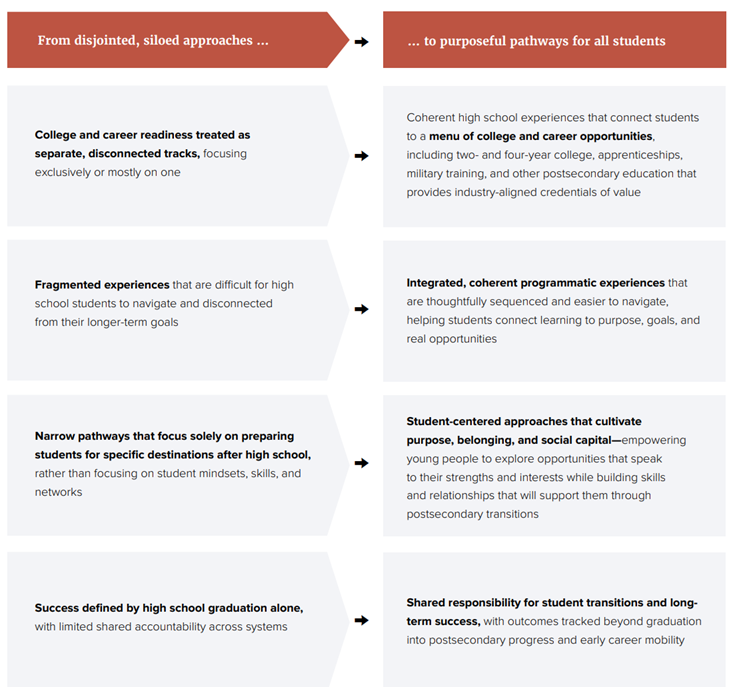
Many of these shifts will depend on creating the conditions necessary for providing these kinds of supports in our K-12 districts and schools. NCAN previously wrote about these when we highlighted a framework that included these strategies for student success for when a school district …
-
…is publicly committed to students’ postsecondary success
-
…sets strategy and allocates resources to reach postsecondary goals
-
…ensures that schools have capacity to support students
-
…collaborates with postsecondary institutions and community partners, and
-
…uses real-time data to continuously improve postsecondary advising and outcomes, empowering students and families
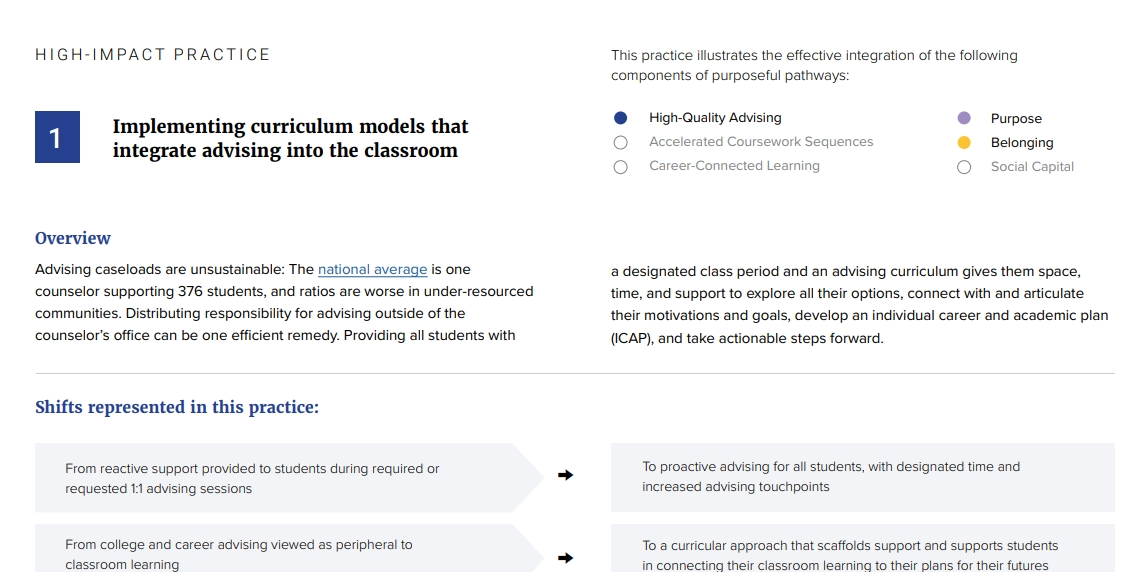
Back to the Launchpad for Life, along with the report the Commission also released three action guides that make approachable recommendations for systems interested in shifting their own work:
OneGoal recently hosted a webinar with a very thoughtful conversation around the “Launchpad for Life” report. It was a very thoughtful conversation with two of the Commission’s co-chairs and other contributors to the report. The conversation is surely worth your time and puts more detail and context around the report’s vision.
At the end of Ari’s story, the report finds her at a regional community college preparing for a career in cyber security. The report concludes by asking, “What will it take for us to stop celebrating this story as an exception and start building the systems that make it the norm for every student?”
NCAN members every day are working toward building and strengthening those systems while supporting individual student and family journeys. Every day we are creating the launchpads from which students’ futures will take off. Give the report and the associated resources a read; I am confident you will pick up a new strategy or approach for your own approach and our collective work.
Want to talk more about systems change that shifts postsecondary advising for students at-scale? I’d love to chat, and my email is [email protected].